Chapter 4
General Equity as Exposition
General Equity as Exposition
Case Laws and the Ten Commandments
The moral law is often treated as though it exists in abstraction, detached from concrete social life. The Ten Commandments are affirmed as timeless, yet they are frequently left undefined, floating above history as moral slogans rather than functioning legal norms. Scripture does not present them this way.
Our Lord Jesus Christ Himself settled this matter at the outset of His ministry. In the Sermon on the Mount, He declared with unmistakable clarity:
“Do not think that I have come to abolish the Law or the Prophets; I have not come to abolish them but to fulfill them. For truly, I say to you, until heaven and earth pass away, not an iota, not a dot, will pass from the Law until all is accomplished. Therefore whoever relaxes one of the least of these commandments and teaches others to do the same will be called least in the kingdom of heaven, but whoever does them and teaches them will be called great in the kingdom of heaven.” (Matthew 5:17-19)
Notice what Christ does not say. He does not say the law was good for its time but has now been replaced. He does not say that love fulfills the law by rendering its commands obsolete. He says not an iota, not a dot, will pass away. And then He spends the remainder of the sermon doing what? Expositing the law. Showing what it truly requires. Demonstrating that murder includes anger, that adultery includes lust, that the law’s demands reach not merely to the hand but to the heart.
This is precisely how the case laws function in the Mosaic economy. The Decalogue stands as the constitutional core, while the surrounding case laws operate as its exposition. These judicial statutes do not compete with the Ten Commandments; they explain them. They show what obedience and violation look like in real, lived situations involving property, family, injury, contracts, and public order.
The Decalogue as Summary
The Apostle Paul makes explicit what is implicit throughout Scripture: the Ten Commandments summarize the moral law, and love fulfills them all:
“Owe no one anything, except to love each other, for the one who loves another has fulfilled the law. For the commandments, ‘You shall not commit adultery, You shall not murder, You shall not steal, You shall not covet,’ and any other commandment, are summed up in this word: ‘You shall love your neighbor as yourself.’ Love does no wrong to a neighbor; therefore love is the fulfilling of the law.” (Romans 13:8-10)
Here Paul lists four commandments from the Second Table and then says “any other commandment” is summed up in love. But notice: he does not thereby dismiss the commandments. He does not say, “Love replaces the commandments.” He says the commandments are summed up in love–they are its content, its specification, its concrete form. To know what love requires, you must know what the commandments forbid.
This relationship between summary and specification is precisely what we find between the Decalogue and the case laws. The Ten Commandments state the principle; the case laws show the application. You cannot understand one without the other.
General Equity in the Reformed Confessions
This relationship is essential for understanding what the Reformed confessions mean by general equity. The Westminster Confession, the Savoy Declaration, and the 1689 London Baptist Confession all affirm that the judicial laws of Israel expired with that nation “excepting the general equity thereof.”
The 1689 London Baptist Confession states it thus:
“To them also he gave sundry judicial laws, which expired together with the state of that people, not obliging any now by virtue of that institution; their general equity only being of moral use.” (1689 LBCF 19.4)
Yet the confessions do not define general equity as an abstract moral residue. Rather, it is discovered by observing how the moral law was applied in concrete cases. The phrase “general equity” does not mean “whatever seems fair to us.” It means the moral reasoning embedded in the law–the justice principle that the specific form was designed to implement.
John Owen provides the theological foundation for this confessional language. The confessions tell us that general equity persists; Owen, in his monumental exposition of the Epistle to the Hebrews, shows us how it works. He gives us two things we desperately need: a ground and a test.1
The ground is this: judicial laws are not free-standing legislation but “applications of the moral law” to Israel’s particular circumstances. They grow out of the Decalogue the way branches grow from a trunk. Because the trunk remains, the moral substance carried by those branches does not vanish when the branches are pruned. The test is equally practical: Owen asks whether both the subject-matter and the underlying rationale of a given command remain constant across the great epochs of redemptive history. Where both persist, the equity persists. Where the rationale was bound to a form that has expired, the equity must be re-expressed rather than woodenly repeated.
These two contributions appear across two key passages in Owen’s Hebrews commentary (Vol. 2 on the nature of the judicial laws, Vol. 5 on the method for identifying natural equity), and the sections that follow will unpack them in detail. We will hear Owen in his own words, map his seventeenth-century vocabulary onto more accessible categories, and then put his framework to work on concrete examples. The reader who stays the course will come away not merely believing that general equity is real, but knowing how to find it.
Case Laws as Worked Examples
The case laws answer questions the Decalogue leaves implicit. What does it mean not to steal when negligence causes loss? How does “you shall not murder” apply to accidental death, self-defense, or reckless behavior? What does honoring authority look like when authority itself fails? These laws do not add new moral content; they specify existing moral obligations under particular conditions.
John Owen stated this principle with a directness that has scarcely been improved upon. In his Exercitations on the Sabbath, he wrote:
“All the judgments relating unto civil things were but an application of the moral law to their state and condition.” (Owen, Hebrews, Vol. 2, Exercitation IV.6)
Mark that language carefully: not a supplement to the moral law, not an addition alongside it, but an application of it. The direction of derivation is from the Decalogue outward. Owen reinforced this elsewhere, calling the judicial law “an explication” of the moral law–that is, an unfolding of what was already present in the Ten Commandments, worked out for Israel’s governance in “judiciary proceedings” (Vol. 5, on Hebrews 7:12). An explication reveals what the source already contains. The case laws do not create new moral obligations; they make explicit what the Decalogue contains in principle.
Owen pressed the point further with a striking argument: “Nor was any thing punished by death judicially in the law but the transgression of some moral command.” Every capital offense in the Mosaic code traces back to a Decalogue violation. The severity of the civil penalty corresponded to the weight of the moral principle behind it. This is not the testimony of a man who treated the judicial laws as arbitrary positive legislation; it is the testimony of one who saw the Decalogue shining through every statute.
A word on vocabulary is warranted here, because Owen’s seventeenth-century scholastic terminology maps directly onto the form/function distinction that this book employs. When Owen speaks of a command’s subject-matter (materia), he means what the law is about: the concrete action or situation it addresses. This is what we call its form, the historically situated elements that belong to a particular time and place. When he speaks of a command’s formal reason (ratio formalis), he means the underlying moral rationale, the why behind the command. This is what we call its function, the moral reasoning that the form was designed to implement. Owen’s test asks whether both materia and ratio formalis remain constant across epochs; ours asks whether the function persists when the form can no longer apply. These are the same question in different idiom. The reader who grasps the form/function distinction already possesses the conceptual equipment Owen deployed, and may turn to his Hebrews commentary with confidence that the vocabulary, though different, maps onto the same reality.2
This correspondence also illuminates a category Owen developed elsewhere in his Exercitations, one that proves especially useful for difficult cases. Not every law in Scripture fits neatly into the categories of “purely moral” or “purely ceremonial.” Some laws are rooted in a genuine moral obligation, yet the specific way that obligation is to be carried out was determined by God’s positive command for a particular covenant arrangement. Owen called these moral-positive laws. Consider tithing as an example. The moral obligation to support the worship of God and those who labor in it is permanent; it flows from the first table of the Decalogue. But the specific requirement to give exactly one-tenth of one’s agricultural produce to the Levitical priesthood was a positive institution, appointed for Israel’s particular covenant circumstances. The moral root persists; the institutional form may change.
Owen expressed the principle this way: a moral-positive law is one whose “foundation” is in “somewhat that is moral” but which “stands in need of the superaddition of a positive command for its due observation” (Vol. 2, Exercitation III). In plainer language, the why behind the law is moral, but the how required God to specify particular details that do not arise from moral reasoning alone. The Sabbath commandment, tithing regulations, and certain judicial penalties all belong to this category. Here is precisely where the form/function distinction earns its keep. When a Christian encounters a moral-positive law, he need not choose between treating it as eternally binding in every detail or dismissing it as irrelevant. Instead, he identifies the moral function (the enduring why), acknowledges the positive form (the covenantally situated how), and asks whether that same function ought to be expressed in a different institutional context. In most cases, the answer is plainly yes.
With Owen’s framework in hand, let us see it at work on a concrete example. The sixth commandment declares, “You shall not murder” (Exodus 20:13). But what counts as murder? What about killing in self-defense? What about death caused by negligence rather than intent? The commandment by itself does not answer these questions. The case laws do.
In Exodus 21:28-36, we find legislation concerning the goring ox:
“When an ox gores a man or a woman to death, the ox shall be stoned, and its flesh shall not be eaten, but the owner of the ox shall not be liable. But if the ox has been accustomed to gore in the past, and its owner has been warned but has not kept it in, and it kills a man or a woman, the ox shall be stoned, and its owner also shall be put to death. If a ransom is imposed on him, then he shall give for the redemption of his life whatever is imposed on him.” (Exodus 21:28-30)
Here the sixth commandment is being exposited. The law distinguishes between an unexpected accident (owner not liable) and culpable negligence (owner has been warned, failed to restrain the dangerous animal, and is now liable for the death). This is not a new moral principle; it is the principle of the sixth commandment applied to a specific circumstance.
Now, you may not own an ox. But do you own a car? A dog? Equipment that could harm others if poorly maintained? The form of the law is bound to an agricultural society. The function (that culpable negligence resulting in death carries serious moral and legal weight) is not bound to anything. It is the sixth commandment rendered concrete.
But What About “The Ministry of Death”?
Before we proceed further, we must reckon with a serious objection. Some contend that this entire enterprise is built on sand. Their argument runs thus: Paul himself calls the Decalogue “the ministry of death, carved in letters on stone” (2 Corinthians 3:7) and says it “came with glory” only so that it might be shown as “being brought to an end” (3:11). Therefore the Decalogue itself is abolished. And if the Decalogue is abolished, then any general equity derived from it is abolished with it. Case laws cannot be expositions of a law that no longer exists.
This is a serious objection, and it deserves a serious answer. Let us give it one.
The argument depends on isolating a single strand of Paul’s extraordinarily complex teaching about the law and treating it as the whole tapestry. But Paul is not a man who speaks of the law in one register only. He is the same apostle who wrote that the law is “holy, and the commandment is holy and righteous and good” (Romans 7:12). He is the one who asked, “Do we then overthrow the law by this faith?” and answered himself with characteristic force: “By no means! On the contrary, we uphold the law” (Romans 3:31). He is the one who told the Romans that the Jews had “an advantage much in every way” because “they were entrusted with the oracles of God” (Romans 3:1-2). He is the one who confessed, “I delight in the law of God, in my inner being” (Romans 7:22).
Are we to believe that this same Paul, within the same body of letters, declared the moral content of the Decalogue worthless and abolished? That he delighted in something that no longer exists? That the Jews’ great advantage was being entrusted with oracles that have been revoked? Such a reading requires Paul to contradict himself within his own epistolary corpus–and that is a price too high for any responsible exegesis to pay.
The resolution lies in understanding what Paul means by “the ministry of death.” Romans 7 provides the essential parallel. There Paul describes his own encounter with the law in language strikingly similar to 2 Corinthians 3:
“I was once alive apart from the law, but when the commandment came, sin came alive and I died. The very commandment that promised life proved to be death to me. For sin, seizing an opportunity through the commandment, produced in me all kinds of covetousness…. For apart from the law, sin lies dead.” (Romans 7:9-11, 8b)
The commandment “proved to be death” to Paul. Does he therefore conclude that the commandment is evil? That it should be abolished? Listen to his immediate answer:
“Did that which is good, then, bring death to me? By no means! It was sin, producing death in me through what is good, in order that sin might be shown to be sin, and through the commandment might become sinful beyond measure.” (Romans 7:13)
And then, lest anyone mistake his meaning:
“So the law is holy, and the commandment is holy and righteous and good.” (Romans 7:12)
Here is the key: the law kills, but it kills through sin. The commandment is not the disease; it is the diagnostic instrument that reveals the disease. A thermometer that reads 104 degrees is not the cause of your fever. The Reformers understood this perfectly. They called it the usus elenchticus–the convicting or pedagogical use of the law. When the holy law of God encounters the unholy heart of man apart from grace, the result is condemnation and death. That is not a statement about the moral content of the commandments; it is a statement about the effect of holy law on unholy people. “The ministry of death” describes a function of the law in relation to sinners, not a deficiency in the law itself.
This is precisely why Paul can call the same law both “death” and “holy, righteous and good” without contradiction. The law that kills the sinner is the same law that guides the saint. What changes is not the content but the recipient and, crucially, the mode of administration.
And here the objection collapses under the weight of its own best proof text. For what does the new covenant promise? Jeremiah 31:33, quoted at length in Hebrews 8:10, tells us:
“For this is the covenant that I will make with the house of Israel after those days, declares the Lord: I will put my laws into their minds, and write them on their hearts, and I will be their God, and they shall be my people.”
Consider what this means. If the content of the law were abolished, there would be nothing to write. The new covenant’s superiority is not that it discards the law but that it internalizes it. The “ministry of death” (the external law carved on stone, encountering unregenerate hearts that could not obey) is replaced by the “ministry of the Spirit” (the same law written internally by regeneration, received with delight by hearts made new). The content remains; the mode of administration changes. Stone gives way to flesh. External demand gives way to internal desire. The letter that kills gives way to the Spirit who gives life. But the moral substance, the commandments themselves, endures, now written where it can actually bear fruit.
This is confirmed by Paul’s own argument in 2 Corinthians 3. His comparison is about glory, not about moral content. The old covenant ministry “came with glory” (3:7); the new covenant ministry has “much more glory” (3:9). But notice: you do not compare glories if one of the things being compared is morally worthless. You do not say “the new surpasses the old in glory” if the old had no glory worth surpassing. Paul’s argument assumes the real, genuine glory of the Sinai ministry–and then declares that the new covenant ministry is more glorious still. He is comparing two modes of administering the same moral reality, not two different moral codes. The old was glorious; the new is surpassingly glorious. What was glorious in its time now seems dim only by comparison to the blazing light of Christ and the Spirit.
Our Lord Himself settled this at the outset. “Do not think that I have come to abolish the Law or the Prophets; I have not come to abolish them but to fulfill them” (Matthew 5:17). If this reading were correct, Christ’s words here would be misleading at best. But they are not misleading. They are definitive. Christ fulfills the law not by emptying it of content but by revealing its fullest meaning, obeying its deepest demands, and securing the Spirit who writes it on His people’s hearts.
The “ministry of death” objection, then, is not an argument against the abiding moral content of the Decalogue. It is an argument about what happens when that content meets the sinner apart from grace. And the answer, the glorious new-covenant answer, is not that the law is thrown away but that the Spirit is given to make obedience possible from the inside out.
With the Decalogue’s abiding authority thus secured, we may press forward to ask a practical question: if the case laws are expositions of an enduring moral law, why did Israel need them in the first place? Could the Ten Commandments not have stood alone?
Why Did Israel Need Case Laws?
But here someone may object: if the case laws merely explain the Decalogue, why did Israel need them separately? Could they not simply have been given the Ten Commandments and left to work out the applications themselves?
The question reveals a misunderstanding of how law functions and how God teaches His people.
First, consider the pedagogical necessity. The Israelites were recently delivered slaves, not trained jurists. They needed not merely principles but examples. They needed to see justice worked out in cases they would actually face. A father explaining “be kind to others” to his child does well; but a father who also says “and that means sharing your toys with your sister, and not hitting your brother when you’re angry, and telling the truth even when it’s hard”–that father has taught his child what kindness actually requires.
Second, consider the judicial necessity. Laws must be administered by human judges. And human judges, being fallen and limited, need guidance. The case laws provided a standard for judgment that was not left to each judge’s private interpretation. When a dispute arose about negligence, the judge did not have to invent the principle; he had God’s own application to reason from.
Third, consider the revelatory purpose. God was not merely governing Israel; He was teaching all subsequent generations what justice looks like. The case laws are Scripture, given for our instruction (Romans 15:4; 2 Timothy 3:16). They show us how God Himself applied His own commandments. What greater authority could there be?
Fourth, consider the noetic effects of the fall.3 Sin has not only corrupted human desires but has darkened human understanding. Paul tells us that the mind set on the flesh is hostile to God and “does not submit to God’s law; indeed, it cannot” (Romans 8:7). Though all people have some knowledge of God’s moral requirements through natural revelation (Romans 1:19-20; 2:14-15), they “suppress the truth in unrighteousness” (Romans 1:18). Left to ourselves, we rationalize injustice, call evil good and good evil, and convince ourselves that our self-serving interpretations are righteous. The case laws restrain this tendency. They do not merely illustrate the Decalogue; they constrain fallen human interpretation of it. When God specifies that the negligent owner of a goring ox bears responsibility for death, He closes the door on our endless capacity to excuse ourselves. The case laws function as a divine check on our noetic corruption: concrete applications that we cannot easily explain away or redefine to suit our preferences.
Every Case Law Maps to a Commandment
This chapter argues that general equity is best understood not as a principle extracted away from the case laws, but as a principle revealed through them. The judicial statutes function as worked examples–authoritative demonstrations of how the Ten Commandments govern social life in a fallen world.
This leads to a methodological principle that will guide our interpretation throughout this book and is developed more fully in Chapter 5: every judicial law should map clearly to one primary commandment. This is not an arbitrary constraint but a recognition of how Scripture itself is organized. The case laws are expositions of the Decalogue. To identify the general equity of a case law, we must first identify which commandment it expounds.
The relationship between commandment and case can be visualized in two directions. First, the forward direction: God can apply the Normative standard (the Ten Commandments) to infinite Situational cases. The same moral principle generates countless applications. In God’s legislative act, the direction was from principle to application: He knew the moral requirement, understood the situation, and gave the case law as the junction of the two.
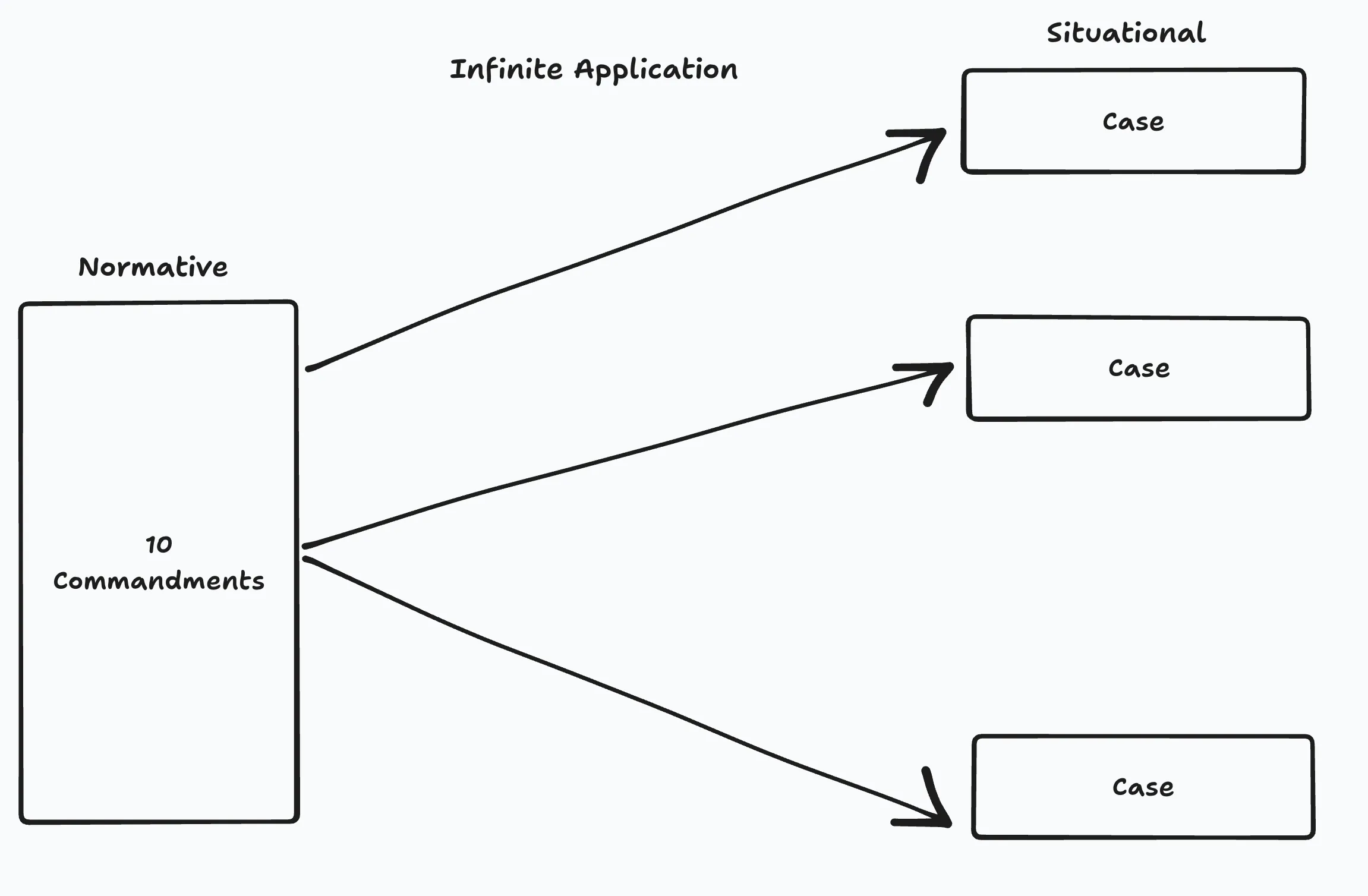
But our interpretive task moves in the reverse direction. We begin with the case law and “walk back” toward the commandment, asking: What moral reasoning connects this principle to this application? What truth about justice does this case presuppose? The answer is the general equity, an intermediate layer of abstraction that sits between the bare commandment and the specific case.
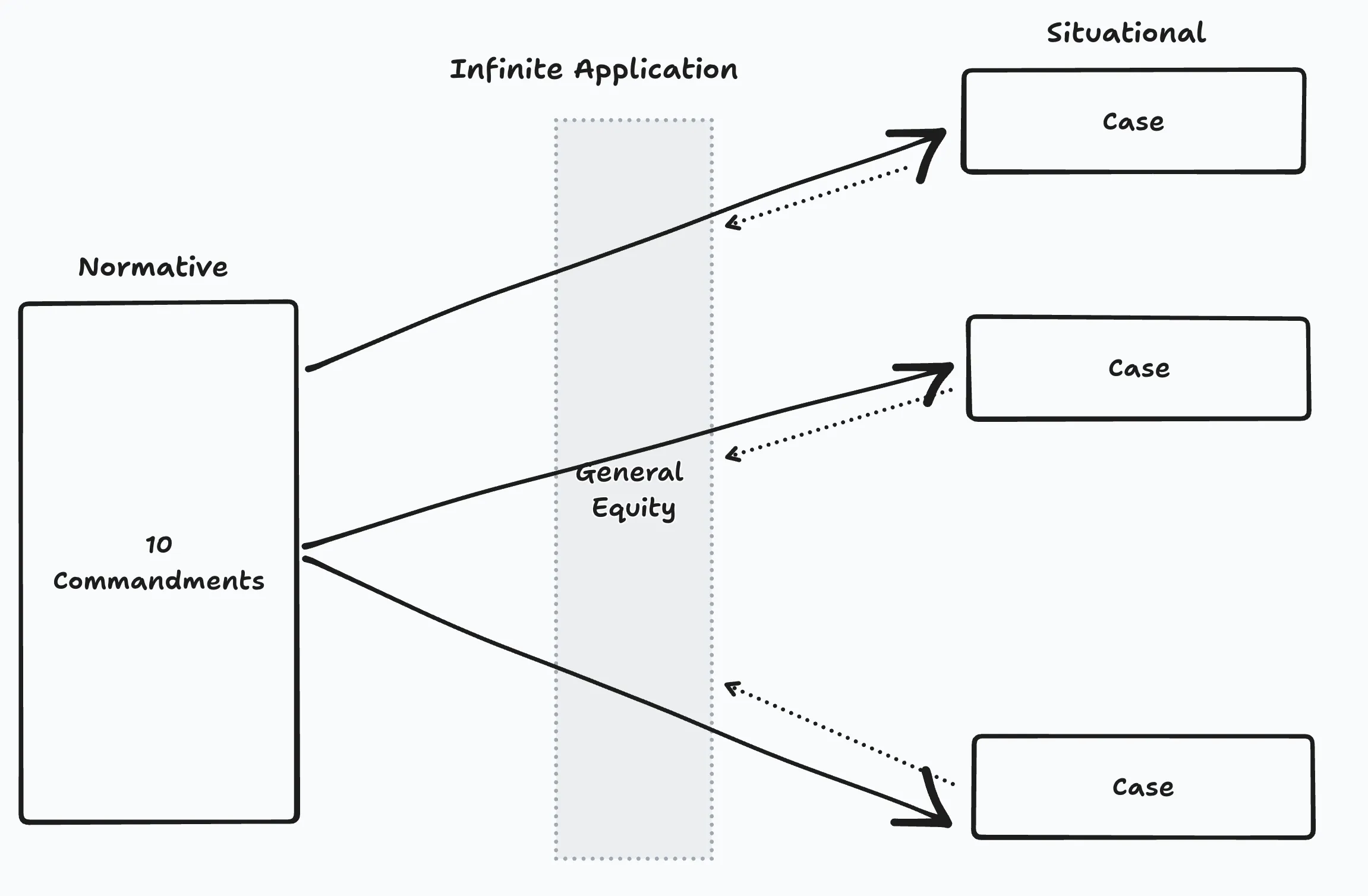
Think of it this way: when a skilled teacher explains a principle, he does not merely state the rule and leave you to flounder. Neither does he only work one problem and expect you to repeat it mechanically. He shows you the reasoning that connects the rule to the example, and that reasoning is what equips you to solve problems you have never seen before. God is such a teacher. The case laws are His worked examples, and the general equity is the reasoning He employed.
Notice what this reveals: general equity is not the case law itself (too narrow), nor is it the bare commandment (too broad). It is the moral reasoning that is more specific than “You shall not steal” but more general than “Don’t muzzle the ox while it treads grain.” For Deuteronomy 25:4, the general equity is something like: “Laborers are entitled to share in the fruit of their labor.” This intermediate layer is what allows the equity to apply to situations the original case never addressed: ministers receiving support, employees receiving fair wages, and countless other applications.
Let us see this mapping concretely. The table below is not exhaustive (we will work through many of these laws in detail throughout the book), but it illustrates how every judicial statute connects to a commandment from which its general equity derives. The “Domain” column identifies the broad area of life each commandment governs, which helps the interpreter recognize where a given case law belongs:
| Commandment | Domain | Case Law Examples |
|---|---|---|
| 1st: No Other Gods | Ultimate Authority | Idolatry prohibitions (Deut. 13:1-18) |
| 2nd: No Images | Worship Form | Destruction of high places (Deut. 12:2-4) |
| 3rd: LORD’s Name | Sacred Speech | Blasphemy penalty (Lev. 24:10-16), vow fulfillment (Num. 30), false swearing (Lev. 19:12) |
| 4th: Sabbath | Appointed Times/Places | Sabbath labor prohibitions (Ex. 35:2-3), sabbatical year (Lev. 25:1-7), rest for servants (Deut. 5:14) |
| 5th: Honor Parents | Human Authority | Cursing parents (Ex. 21:17), striking parents (Ex. 21:15), stubborn son (Deut. 21:18-21) |
| 6th: Murder | Life and Person | Goring ox (Ex. 21:28-36), cities of refuge (Num. 35), parapet requirement (Deut. 22:8) |
| 7th: Adultery | Marriage and Sexuality | Seduction laws (Ex. 22:16-17), divorce regulations (Deut. 24:1-4) |
| 8th: Theft | Property Rights | Theft restitution (Ex. 22:1-4), wages (Deut. 24:14-15), muzzled ox (Deut. 25:4) |
| 9th: False Witness | Trial and Due Process | Two witness rule (Deut. 19:15), false witness penalty (Deut. 19:16-21) |
| 10th: Coveting | Heart and Contentment | Landmark removal (Deut. 19:14), oppression of poor (Deut. 24:17-18) |
You will notice that we have included examples from both Tables of the law. This is deliberate. The same philonomic method applies to the entire Decalogue. The First Table commandments–those governing our duty to God–are no less exposited by case laws than the Second Table commandments governing our duty to neighbor. Laws against idolatry, blasphemy, and Sabbath-breaking all follow the same pattern: a commandment states the principle; case laws demonstrate its application in concrete circumstances. We develop the First Table applications more fully in Chapter 10, where we address the distinctive questions they raise for civil society. But the method is one method. The Decalogue is one law. And God’s wisdom in applying it is consistent throughout.
This is not an exhaustive table but an illustration. The point is methodological: when you encounter a case law and wish to identify its general equity, ask first which commandment it expounds. The domain column in the table above provides a first approximation; the answer will often be obvious from the subject matter. Where the law concerns death or bodily harm, look to the sixth commandment. Where it concerns property or wages, look to the eighth. Where it concerns testimony or legal procedure, look to the ninth.
The form of the law–goring oxen, parapet requirements, landmarks–belongs to ancient Israel. The function of the law–protecting life from negligence, securing property rights, ensuring honest testimony–belongs to justice itself.
A precise definition is warranted here, as the form/function distinction is fundamental to the philonomic method. But the distinction cannot be made hastily. Before we can separate form from function, we must first do two things: identify what cannot transfer at all (the discipline of wooden literalism), and surface all the assumptions the text takes for granted (presuppositional analysis). By this we mean surfacing not only what the text states but what it assumes about justice, authority, labor, and the parties involved. Only then can we cleanly distinguish what is culturally bound from what is morally foundational. (See Chapter 3, “Clearing the Ground,” for fuller treatment of these categories.)
By form, we mean those elements of a law that are historically, geographically, or technologically bounded: elements that belong to ancient Israel’s particular circumstances and cannot be directly transferred to other contexts. These include:
- Agricultural practices (threshing with oxen, gleaning corners of fields)
- Architectural assumptions (flat roofs used for daily activities)
- Economic structures (specific livestock, monetary values, land allotments)
- National administration (tribal boundaries, theocratic courts, temple-centered worship)
By function, we mean the moral reasoning that the form was designed to implement: the principle of justice that the command embodies. The function answers the question: What wrong does this law restrain, and what good does it protect? Crucially, the function emerges from careful analysis of what the text presupposes, not from the interpreter’s intuition about what seems reasonable. When we surface all the assumptions a law takes for granted (assumptions about authority, relationships, labor, value, and justice), the moral function becomes visible. It is discovered, not imposed.
A word of honest qualification is necessary here. The form/function distinction is powerful, but it is not always self-evident. For many case laws (the goring ox, the parapet law, the unmuzzled ox) the boundary between form and function is clear from the text itself. But there exists a class of laws where the distinction is genuinely debatable: laws with pre-Mosaic attestation, multi-epoch presence, and boundaries between institutional specification and moral substance that careful interpreters may draw differently. Tithing is perhaps the most prominent example. Is the specific proportion (one-tenth of agricultural produce) the form, or is it part of the function? The synchronic analysis4 of the law as given within the Torah can yield ambiguous results in such cases. This is not a fatal weakness in the method; it is an honest acknowledgment of the kind of difficulty that arises when fallen interpreters handle divine legislation. Chapter 5 addresses this through an enhanced step (Step 4b), drawing on Owen’s formal-reason test, which provides additional discriminating power precisely where the form/function boundary is hardest to draw.
This leads to an important distinction in hermeneutical orientation. The philonomic method, as developed in this book, works primarily synchronically–that is, it examines a law as given at a single point in redemptive history, surfaces its presuppositions, separates form from function, and maps it to the Decalogue. This synchronic orientation gives the method its universal scope: it can be applied to any Mosaic case law, whether or not that law has parallels in other epochs. But Owen’s formal-reason test works diachronically–it tracks a practice across redemptive history, comparing its rationale in the pre-Mosaic, Mosaic, and post-Mosaic periods. Where both the subject-matter and the formal reason remain constant across epochs, the command is “of natural equity, and unalterable.” Where the subject-matter persists but the formal reason varies, the specific form is not permanent, though the moral substance may be.
These two orientations are complementary, not competitive. The synchronic method provides the comprehensive base; the diachronic test provides a precision supplement for cases where synchronic analysis alone is under-determined. Most case laws will never need the diachronic tool–the text itself makes the form/function distinction plain. But for the hard cases, Owen’s test narrows the zone of interpretive judgment without eliminating it entirely. A method that acknowledges its limitations and provides tools to address them is more trustworthy than one that claims unlimited precision.
To see concretely how the diachronic test works–and, crucially, how it can yield a negative result–consider the prohibition against eating blood. The same practice (abstaining from blood) appears before the law (Gen. 9:4), under the law (Lev. 17:5-14), and after the law (Acts 15). If continuity of form across epochs were sufficient to prove moral permanence, this would settle the matter. But Owen shows that the function differs in each epoch: before the law, the prohibition restrained the savage custom of eating raw flesh; under the law, God reserved blood for sacrificial use; in Acts 15, the prohibition was a temporary pastoral accommodation to avoid scandalizing Jewish believers. Same form, three different functions–therefore not morally permanent in its specific expression. The test is falsifiable, and that is precisely what makes it trustworthy. (The full worked example appears in Chapter 5, Step 4b.)
This distinction is not arbitrary but is grounded in how Scripture itself treats the law. When Paul reasons from Deuteronomy 25:4, he does not insist on the form (literal oxen) but identifies the function (laborers deserve fair compensation) and applies it to a new context. The form was for Israel; the function is for justice wherever justice is sought. Paul’s reasoning demonstrates that the function was always there, embedded in the law’s assumptions, waiting to be drawn out and applied.
The full seven-step method for working through this process is developed in Chapter 5, “The Philonomic Method.” There you will find not only the steps but worked examples demonstrating how exhaustive presuppositional analysis grounds the form/function distinction in the text itself.
When the Form No Longer Applies
When the form of a law is no longer applicable, its moral reasoning often remains not only relevant, but indispensable. Consider again the parapet law:
“When you build a new house, you shall make a parapet for your roof, that you may not bring the guilt of blood upon your house, if anyone should fall from it.” (Deuteronomy 22:8)
Flat roofs used for daily activities were common in ancient Israel. They are not common in modern construction. Does this mean the law is irrelevant? Not at all. The law teaches that property owners bear responsibility for foreseeable dangers on their property. Swimming pools require fences. Staircases require railings. Hazardous conditions require warning. The form has changed; the moral reasoning has not.
Philonomy treats these case laws as legal wisdom embedded in history. Some features are culturally bounded; others are logically necessary for justice itself. The task of the interpreter is to distinguish between the two without severing the moral law from its concrete expressions.
The Case Laws as Divine Instruction
In this sense, the Mosaic case laws are not peripheral to biblical ethics. They are the bridge between divine command and human society. To ignore them is to affirm the Ten Commandments in theory while refusing to learn how God himself applied them in practice.
This is what distinguishes philonomy from both antinomianism and a merely abstract moralism. The antinomian says, “We are under grace, not law,” and thereby loses the content of what love requires. The abstract moralist says, “Love your neighbor,” but has no concrete guidance for what that looks like when negligence causes harm, when wages are withheld, when testimony is false.
The philonomist says: God has not left us without instruction. He gave us His commandments. And then, in His wisdom, He showed us what those commandments mean in a thousand different circumstances. The forms were for Israel; the wisdom is for all who have ears to hear.
“Oh how I love your law! It is my meditation all the day” (Psalm 119:97). The psalmist did not love an abstraction. He loved a law that touched every area of life–a law that had been worked out, applied, demonstrated in case after case. This is what God has given us. Let us not despise the gift by leaving the case laws unread, or by treating them as mere historical curiosities.
They are Scripture. They are instruction. They are the very equity we seek to understand.
Footnotes
-
By “ground” we mean the question of what judicial laws are in their very nature, that is, their relationship to the moral law as such. By “test” we mean the method by which a reader of Scripture discerns what moral content persists after the Mosaic covenant has expired. Owen addresses both questions, and both are necessary: without the ground, we have no reason to look for abiding equity; without the test, we have no way to identify it responsibly. ↩
-
Owen’s vocabulary derives from the scholastic tradition he inherited. Materia (subject-matter) and ratio formalis (formal reason) are standard Aristotelian-Thomistic categories for distinguishing what a thing is about from why it is what it is. Readers wishing to study Owen’s formal-reason test in its original context will find it in his exposition of Hebrews 7:4 (Vol. 5 of An Exposition of the Epistle to the Hebrews), where he uses the blood-eating prohibition across three epochs as a counter-example to demonstrate that continuity of subject-matter alone does not prove moral permanence. His ontological claim that judicial laws are “applications of the moral law” appears in Vol. 2, Exercitation IV.6. ↩
-
“Noetic” comes from the Greek nous (mind). The noetic effects of the fall are the ways in which sin has darkened and distorted human reasoning, so that we suppress, rationalize, and misapply moral truths we would otherwise recognize. See also Chapter 2, where this concept is introduced more fully. ↩
-
Synchronic analysis examines a law at a single point in time, asking what it meant within the Mosaic economy as given. Diachronic analysis, by contrast, tracks a practice across multiple epochs of redemptive history. Both terms are explained more fully in the paragraphs that follow. ↩